The best way to help your child with fractions at home is to slow down and make them visual. Fold paper, cut a sandwich, draw a number line. Most fraction mistakes come from treating the top and bottom numbers like two separate whole numbers. Once a child sees a fraction as one amount, the rules start to make sense.
This guide is for parents of third, fourth and fifth graders in Dayton and the surrounding Miami Valley, from Sidney, Troy and Piqua to Tipp City and the Dayton suburbs. You don’t need to remember how you learned fractions. To help your child with fractions, you just need a few simple habits and some patience.
What your child is learning about fractions, grade by grade
It helps to know where your child is in the sequence. Here’s a plain-English summary of Ohio’s Learning Standards for Mathematics:
- Third grade: What a fraction means, fractions on a number line, simple equivalent fractions like 1/2 = 2/4, and comparing fractions with the same top or bottom number. Denominators stay small: 2, 3, 4, 6 and 8.
- Fourth grade: More equivalent fractions, comparing fractions with different tops and bottoms, and adding and subtracting fractions with the same denominator.
- Fifth grade: Adding and subtracting fractions with different denominators, including mixed numbers.
So if your fourth grader is struggling with adding 1/2 + 1/3, that’s not a sign something is wrong. It’s a fifth-grade skill.
Why fractions feel so hard for kids
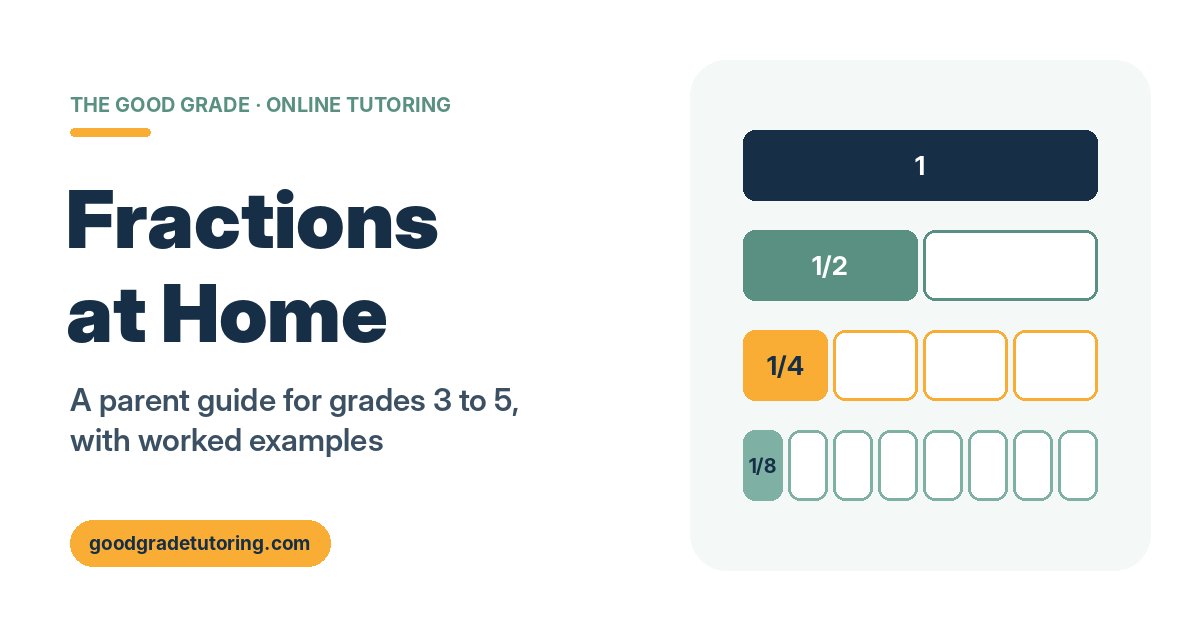
For years, bigger numbers have meant bigger amounts. Then fractions come along and 1/8 is smaller than 1/4, even though 8 is bigger than 4. That feels backward to a child, and it’s the root of a lot of fraction confusion.
Researchers who study fraction teaching say the same thing. A practice guide from the U.S. Institute of Education Sciences, Developing Effective Fractions Instruction for Kindergarten Through 8th Grade, recommends building on kids’ everyday sense of fair sharing, and using number lines to show that fractions are numbers, just like 3 or 10.
Both ideas are easy to bring home.
How to help your child with fractions, step by step
1. Start with fair sharing
Kids understand “fair” long before they understand fractions. Use that. At snack time, ask questions like these:
- “If you share this granola bar fairly with your brother, how much does each of you get?”
- “Would you rather have one-third of the pizza or one-sixth? Why?”
The key word is equal. A fraction only works when the parts are the same size. If your child cuts a sandwich into one big piece and one tiny piece, those aren’t halves, and that’s worth talking about.
2. Fold paper strips
Cut a few strips of paper the same length. Fold one in half, one in fourths and one in eighths, then label the parts. Lay them side by side, and your child can see that 1/2 lines up with 2/4 and 4/8. That’s equivalent fractions, without a single rule to memorize.
3. Put fractions on a number line
Draw a line from 0 to 1. To find 2/3, split the space between 0 and 1 into three equal jumps. Count two jumps from 0. That’s where 2/3 lives.
Now try 4/3. Keep making jumps of the same size past 1. Your child will see that 4/3 lands a little past 1, which is exactly what it means: one whole and one more third.
4. Ask “about how big?” before solving
Before your child works out any fraction problem, ask: “Is the answer more than one half or less? More than one or less?” This one habit catches a huge number of mistakes, as you’ll see in the examples below.
Three worked examples (and the tempting wrong answers)
Here are three problems you can try together. Each one comes with the mistake kids most often make, and why it’s wrong.
Example 1: Which is bigger, 3/4 or 3/8?
Tempting wrong answer: “3/8, because 8 is bigger than 4.”
How to think about it:
- Both fractions have 3 pieces. The only question is how big each piece is.
- Fourths come from cutting a pizza into 4 equal slices. Eighths come from cutting the same pizza into 8.
- The more slices you cut, the smaller each slice gets. So 3 big slices beat 3 small slices.
Answer: 3/4 is bigger. The bottom number tells you how many pieces the whole is cut into, so a bigger bottom number means smaller pieces.
Example 2: Fill in the blank: 2/3 = ?/12
Tempting wrong answer: 11. A child sees that 3 became 12 by adding 9, so they add 9 to the top too: 2 + 9 = 11.
How to think about it:
- Going from thirds to twelfths means cutting each third into 4 smaller pieces, because 3 × 4 = 12.
- If each of the 2 pieces gets cut into 4, you now have 2 × 4 = 8 pieces.
- So 2/3 = 8/12. You multiplied the top and bottom by the same number.
Why 11/12 can’t be right: 2/3 is a little more than half. But 11/12 is almost a whole. They aren’t close to the same size, so they can’t be equal. This is where the “about how big?” habit pays off.
Example 3 (fifth grade): What is 1/2 + 1/3?
Tempting wrong answer: 2/5. A child adds the tops (1 + 1 = 2) and the bottoms (2 + 3 = 5).
How to think about it:
- Halves and thirds are different-sized pieces, so you can’t add them as they are. You need pieces of the same size first.
- Sixths work for both: 1/2 = 3/6 and 1/3 = 2/6.
- Now the pieces match: 3/6 + 2/6 = 5/6.
Why 2/5 can’t be right: 2/5 is less than 1/2. You can’t start with half a pizza, add more pizza, and end up with less than half. Ask your child to check that before they ever write an answer down.
Everyday ways to practice fractions
- Cooking: Let your child measure with 1/4 and 1/3 cups. Ask how many 1/4 cups make a whole cup.
- Time: A quarter past the hour is 1/4 of the way around the clock. Half past is 1/2.
- Money: A quarter is 1/4 of a dollar. Two quarters make 2/4, which is the same as 1/2.
- Sports and games: If a basketball game has 4 quarters and 3 are done, what fraction of the game is left?
Five minutes of this a few times a week does more than one long, frustrating homework night. If homework is turning into a battle, our guide to homework help that actually works has more ideas for getting unstuck without tears.
When to get extra help
Fractions build on each other. A child who isn’t sure what 1/4 means will have a hard time with 3/4 + 1/8 a year later, and a much harder time with algebra after that. It may be worth getting extra support if your child:
- Still thinks 1/8 is bigger than 1/4 after you’ve worked through examples together
- Gets upset or shuts down when fractions come up
- Can follow the steps with you but can’t do them alone the next day
Our one-on-one online math tutoring works with elementary students at their own pace. We’re a husband-and-wife team based in Sidney, and we work with families across the Dayton area and the Miami Valley. Every session is live over video, so there’s no driving across town after school. Your child can join from the kitchen table.
The bottom line
You don’t need to be a math expert to help your child with fractions. Keep it visual, ask “about how big?” before solving, and use everyday moments like snacks, recipes and clocks. Small, steady practice builds the understanding your child will lean on for years.
Want a second set of eyes on your child’s fraction skills? Book a free 30-minute consultation and we’ll talk through where your child is and what would help most. Prefer to start on your own? Our free Basic Math Cheat Sheet and Basic Math practice test are on our free math resources page.
Frequently asked questions
What grade do kids learn fractions?
Under Ohio’s Learning Standards, formal fraction work starts in third grade with what a fraction means, number lines and simple comparisons. Fourth graders add and subtract fractions with the same denominator. Fifth graders add and subtract fractions with different denominators. Many kids see halves and fourths informally even earlier.
Why does my child think 1/8 is bigger than 1/4?
Because 8 is bigger than 4, and with whole numbers bigger always meant more. Show them a pizza cut into 4 slices next to one cut into 8. The more slices you cut, the smaller each one gets, so 1/8 is the smaller piece. Paper strips work well too.
Should I teach my child the shortcut for adding fractions?
Make sure they understand why it works first. If your child knows that you need same-sized pieces before you can add, the steps will make sense and stick. A shortcut learned without that reason tends to get mixed up later, especially when fractions show up again in algebra.
How much fraction practice should we do at home?
Short and regular beats long and stressful. Five to ten minutes a few times a week is plenty for most elementary students. Mix in everyday moments like measuring for a recipe or reading a clock, so practice feels like part of life instead of extra homework.